> For the complete documentation index, see [llms.txt](https://docs.vooi.io/llms.txt). Markdown versions of documentation pages are available by appending `.md` to page URLs; this page is available as [Markdown](https://docs.vooi.io/vooi-pro-v1/vooi_pro-operationalguidelines/position-types.md).
# Position Types
## Understanding Long and Short
In leveraged trading you can open two types of positions:
1. **Long:** you profit if the price goes **up**
2. **Short:** you profit if the price goes **down**
Let's see how long and short positions work in leverage trading.
{% hint style="info" %}
You place orders to open positions. For more information about order types, please refer to [Order Types](/vooi-pro-v1/vooi_pro-operationalguidelines/order-types.md)
{% endhint %}
### Long Position
A **long position** means you expect the asset price to **increase**.
**How it works:**
* **Open Position:** Buy the asset.
* **Close Position:** Sell the asset.
**Example**
You open a long position on BTC, buying 1 BTC
* Entry price: **80,000 USDC**
| Price | Result |
| ----------------------- | ---------------------- |
| BTC rises to **90,000** | Profit **10,000 USDC** |
| BTC drops tp **75,000** | Loss **5,000 USDC** |
### Short Position
A **short position** means you expect the asset price to **decrease**.
**How it works:**
* **Open Position:** Sell the asset.
* **Close Position:** Buy the asset back.
**Example:**
You open a short position on BTC, selling 1 BTC
* Entry price: **80,000 USDC**
| Price | Result |
| ------------------------ | --------------------- |
| BTC drops top **75,000** | Profit **5,000 USDC** |
| BTC rises to **90,000** | Loss **10,000 USDC** |
### Hedging
Hedging is a risk management strategy used to reduce exposure to price movements.
It works by opening an offsetting position against an existing one. This can help reduce losses if the market moves in the opposite direction.
A hedge can be:
* **full**, when the offsetting position is equal in size
* **partial**, when the offsetting position reduces only part of the risk
For example:
* Long ETH: **1 ETH**
* Short ETH: **0.5 ETH**
If the ETH price falls:
* the long position loses value
* the short position gains value
#### How to Hedge
Not all venues allow traders to keep offsetting positions open at the same time on the same pair.
There are usually two models:
* **One-way mode:** if a trader already has a long position and opens a short position on the same market and pair, the short usually reduces, closes, or reverses the existing long position.\
If a venue does not support hedge mode, an offsetting position can still be opened on a different venue.
* **Hedge mode:** the venue allows both long and short positions to remain open on the same pair at the same time.
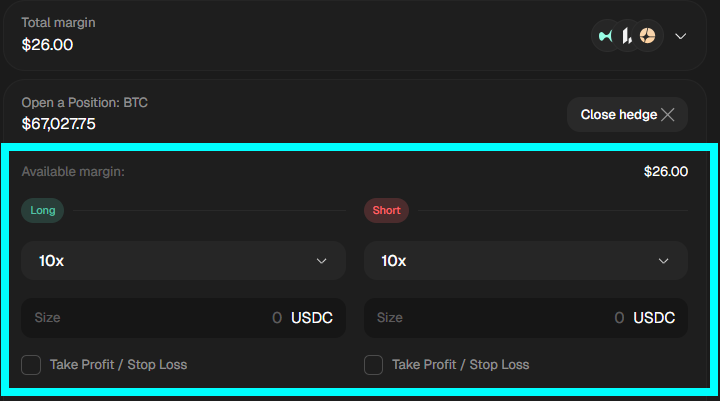
**VOOI Ultra** supports hedging across supported venues, allowing traders to keep both long and short positions open on the same trading pair at the same time:
## Understanding Leverage
### What is Leverage
Leverage allows traders to open positions that are larger than the amount of funds they deposit.
Instead of using the full position value, the trader provides only a portion of it as **collateral (margin)**. The rest of the position value is effectively borrowed within the trading system.
**Example:**
| Collateral | Leverage | Position size |
| ---------- | -------- | ------------- |
| 1,000 USDC | 10x | 10,000 USDC |
In this example, the trader uses **1,000 USDC** as collateral to control a **10,000 USDC** position.
Leverage increases both potential **profits and losses**.
### Collateral (Margin)
Collateral is the amount of your funds allocated to open and maintain a leveraged position.
Collateral serves two purposes:
* It allows the position to be opened
* It absorbs potential losses if the market moves against the position
### **Position Liquidation**
**Liquidation** is the automatic closing of a leveraged position when the losses approach the collateral used for that position.
When you open a leveraged position you risk only your collateral used for the position. If the market moves strongly against the position, losses reduce the collateral, but not borrowed funds.
When the collateral becomes too small to support the position, the system automatically closes it. This process is called **liquidation**.
**Example:**
Collateral: **2,000 USDC**\
Leverage: **40x**\
Position size: **80,000 USDC**
You open a **long BTC position** at **80,000 USDC, buing 1 USDC**
If the BTC price falls, the position starts losing value. These losses are deducted from the **2,000 USDC collateral**.
If the price drops far enough and most of the collateral is used to cover losses, the system will automatically close the position to prevent further losses. This automatic closure is called **liquidation**.
In this case, the position would theoretically lose all collateral if the price dropped to about 78,000 USDC.
In practice, liquidation usually happens earlier (for example around 78,500–79,000 USDC) due to maintenance margin requirements and trading fees.
How Leverage Affects Liquidation
| Leverage | Approx. price move to liquidation |
| -------- | --------------------------------- |
| 5x | \~20% |
| 10x | \~10% |
| 20x | \~5% |
| 40x | \~2.5% |
Actual liquidation levels may vary depending on:
* maintenance margin requirements
* trading fees
* funding payments
* platform-specific risk parameters
.png?alt=media&token=a03b5eec-b27b-4913-ba4e-145eae742678)